

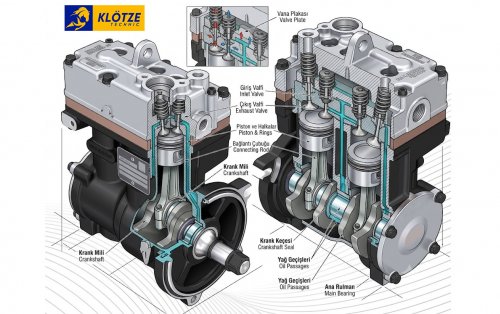
In the heavy-duty commercial vehicle sector, the air brake compressor is far more than just a component that stops the truck. It is the vital heartbeat of the entire pneumatic system, governing the foundation brakes, the air suspension, and often critical transmission controls.
As a seasoned spare parts specialist, I cannot stress this enough: compressor failures are rarely isolated incidents. They frequently trigger a catastrophic domino effect, leading to exponentially higher repair costs—think contaminated air dryers, ruined valves, and eventually, damaged EBS/ABS modules.
Premature compressor failure or performance degradation almost always boils down to two primary enemies: Improper Lubrication and Thermal Stress. In this technical guide, we will explore how to manage these two critical factors to slash your operating costs and minimize expensive downtime.
Most modern heavy-duty air brake compressors are lubricated directly by the engine's oil supply. Simply put, the cleaner your engine oil, the longer your compressor will last.
The compressor circulates engine oil through incredibly fine internal galleries and bearings. If the engine oil is not changed at strict OEM intervals—along with the filters—abrasive particles (soot, metal debris, carbon) suspended in the oil act like liquid sandpaper inside the compressor. This leads directly to low oil pressure at the compressor and accelerated bearing wear.
Expert Tip: Never extend engine oil change intervals to save a few dollars. Furthermore, using low-quality or incorrect viscosity oil can cause an instantaneous lack of lubrication during cold starts, damaging internal components.
Leaks at the compressor’s crankshaft seal or gasket interfaces aren't just an oil loss issue. They signal that the compressor is likely forcing engine oil into the compressed air stream—a phenomenon known as "oil carryover."
This oil travels downstream and wreaks havoc. It immediately compromises the air dryer cartridge, clogs the four-circuit protection valve, and—worst of all—attacks the rubber seals inside the foot brake valves and EBS modulators, potentially causing the entire brake system to lock up.
Spare Parts Warning: If you find excessive oil in your air reservoirs or purge valves, simply changing the air dryer cartridge is not enough. You must address the root cause by inspecting the compressor's piston rings or replacing the unit.
The physical process of compressing air generates immense heat. When a compressor exceeds its designed operating temperature, metal fatigue accelerates, and the lubricating oil rapidly degrades (coking).
Many heavy-duty compressors are integrated into the engine's coolant circuit. Engine coolant circulates through the compressor jacket to absorb heat before returning to the radiator.
Clogged Passages: If the engine cooling system suffers from neglect, scale buildup, or casting sand, the coolant passages around the compressor will constrict. Unable to shed heat, the compressor head area quickly overheats.
External Airflow: The cooling fins on air-cooled compressors or the block itself must be kept clean. If they are caked in mud, oil, and road grime, ambient airflow cannot dissipate the heat.
The Solution: Maintain strict coolant system chemistry (using proper antifreeze/inhibitors) and pressure wash the compressor exterior regularly to keep fins clean.
The source of the air the compressor inhales matters. A restriction in the intake line causes the compressor to pull a vacuum, increasing internal temperatures and drastically reducing efficiency.
Additionally, on turbocharged engines, if the charge air (intake air) is excessively hot before entering the compressor, the compressor starts its cycle already overheated, compounding thermal stress.
Based on our experience in the parts sector, driver behavior and maintenance routines directly correlate to compressor longevity.
Extended Idling: At low idle, the engine oil pump operates at lower pressure. If the compressor is demanding maximum air output simultaneously, it creates a condition of marginal lubrication, accelerating wear.
Air Dryer Maintenance: The primary job of the air dryer is removing moisture. However, a neglected dryer can allow water to freeze in the system or cause the compressor unloader valves to stick open. This forces the compressor to run continuously "unloaded," generating excessive heat without doing useful work.
Using Genuine, Quality Spare Parts: When rebuilding a compressor, using "will-fit" or sub-standard gaskets, unloader valves, or piston rings is a false economy. These cheap alternatives rarely meet OEM tolerances and cannot withstand the extreme heat cycles, leading to premature re-failure.
Adopt these six points as standard operating procedure for your fleet or workshop to maximize compressor lifespan:
Change Engine Oil & Filters on schedule using high-quality, OEM-approved oil.
Keep Compressor Coolant Lines clear and ensure the cooling system is flushed and uses proper antifreeze.
Inspect Intake Hoses and clamps regularly to ensure there are no leaks or restrictions.
Replace the Air Dryer Cartridge annually, preferably before the onset of winter.
Check Drive Belt Tension and alignment during routine services to ensure efficient operation.
Investigate Oil or Excessive Water in the system immediately; do not delay—diagnose the compressor and dryer.
Remember, a quality air brake compressor, properly maintained, is your primary insurance policy on the road.


