

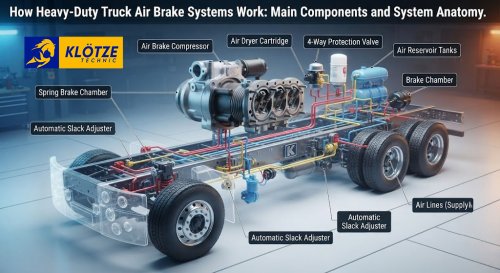
In the heavy-duty commercial vehicle sector—covering trucks, tractors, and buses—safety is the absolute baseline. Stopping a vehicle weighing up to 40 tons requires immense mechanical force, far beyond the capabilities of standard passenger car hydraulic systems. This is where the Air Brake System comes into play.
But how exactly does a heavy-duty air brake system operate? What does the anatomy of the system look like, from the heart of the setup—the air brake compressor—to its critical sub-components? In this technical guide, we break down the engineering secrets of truck braking systems and outline what to look for when selecting high-quality replacement parts.
Passenger cars rely on an incompressible liquid (hydraulic fluid) to transmit braking force. However, in heavy-duty logistics, hydraulic lines are prone to overheating under extreme loads, and a single leak can instantly cause total brake failure.
Air brake systems use compressed air instead. The primary advantage is that atmospheric air is infinite; even if a minor leak occurs, the compressor keeps generating air to maintain safety. Furthermore, as a fail-safe measure, if the system loses all air pressure, the vehicle doesn't roll freely—instead, heavy mechanical Emergency Spring Brakes automatically lock up to bring the vehicle to a safe halt.
The flawless performance of an air brake system relies on the perfect synchronization of high-quality components. Here is the anatomical breakdown of the heavy-duty air system:
The engine of the brake system. Driven directly by the truck's engine (via gears or belts), the compressor draws in atmospheric air, compresses it, and pumps high-pressure air into the reservoirs.
Spare Parts Tip: The quality of the cylinder head, subplate/reed valves, and piston rings directly dictates the service life of the compressor.
When the compressor squeezes air, the process generates extreme heat, moisture, and trace amounts of vaporized engine oil. The Air Dryer cools the air and captures this moisture and oil before it can travel further down the line.
Critical Sub-Component: The Air Dryer Cartridge. If not replaced at recommended intervals, oil and water will bypass the filter, clogging expensive electronic valves and causing lines to freeze in winter.
This component acts as the "traffic cop" of the pneumatic network. It distributes compressed air into separate, independent circuits: front brakes, rear brakes, trailer lines, and auxiliary systems (like cabin suspension or clutch servos). If a leak occurs in one circuit, the 4-way valve isolates that specific line, preserving pressure in the remaining safe circuits.
Steel or aluminum storage tanks that hold pressurized air. They maintain enough reserve pressure to allow the driver to stop the vehicle safely several times even if the engine dies.
When the driver steps on the brake pedal, this valve finely regulates exactly how much pressurized air from the reservoirs is released to the brake chambers based on pedal pressure.
These cylinders convert pneumatic pressure into mechanical force. During service braking, air fills the chamber, pushing a flexible diaphragm and activating the brake pushrod. Spring brake chambers feature a dual-layer design containing a powerful mechanical spring that applies the parking brake when air pressure is intentionally released or accidentally lost.
The slack adjuster links the brake chamber pushrod to the brake camshaft. As the brake linings (pads) wear down over time, this mechanical component automatically adjusts the clearance between the lining and the drum. It is a critical sub-part for maintaining precise stopping distances.
The pneumatic circuit follows a highly reliable engineering loop:
Air Generation: As long as the engine runs, the Air Brake Compressor continuously generates pressure.
Purification: The hot, compressed air passes through the Air Dryer Cartridge to strip away moisture and carbonized oil particles.
Distribution & Storage: The 4-Way Protection Valve routes the clean air to the designated front, rear, and auxiliary reservoirs at a safe operational pressure (typically 8 to 12 bar).
Brake Application: The driver presses the brake pedal, commanding the Foot Valve to dump pressurized air into the Brake Chambers.
Mechanical Stopping Force: The air pressure expands the chamber diaphragm, forcing the Slack Adjuster forward. This rotates the S-camshaft, pushing the brake shoes outward against the brake drum. The resulting friction slows or stops the vehicle.
Brake Release: When the driver lifts their foot, the air inside the chambers is quickly exhausted to the atmosphere through quick-release valves, and return springs pull the linings away from the drum.
In heavy-duty fleet operations, unexpected downtime is usually traced back to air system contamination and compressor degradation. Keep these technical insights in mind to protect your fleet:
Tackle Carbon Buildup: If a compressor runs too hot or suffers from cooling system restrictions, the lubricating oil inside bakes, forming heavy carbon deposits (Carbon Buildup). This clogs discharge lines and seizes reed valves. Choosing compressors built with premium cooling architecture mitigates this risk.
Compressor Pumping Oil: If you notice a sludge-like mixture of oil and water draining from your air tanks, the compressor piston rings are worn. A compressor that is pumping oil will rapidly contaminate the air dryer cartridge, ultimately leading to catastrophic failure of sensitive ABS/EBS modulators.
The "Cheap vs. Quality" Reality: Cutting corners on pneumatic valves or compressor components might save money upfront, but it dramatically increases your Total Cost of Ownership (TCO). Substandard parts fail prematurely, leading to road freight delays, high towing fees, and severe safety liability. Opting for premium aftermarket brands like Klötze Technic—which adhere strictly to global manufacturing standards—ensures long-term operational reliability and on-road security.
From the initial compression phase to the mechanical clamping of the drum, a heavy-duty air brake system demands absolute component synergy. Understanding the anatomy of this system and choosing reliable, certified spare parts is the most effective way to optimize fleet uptime and guarantee safety across long-haul routes.
air brake system, air brake compressor, truck brake anatomy, slack adjuster, 4-way protection valve, truck compressor pumping oil, heavy-duty spare parts, Klötze Technic.


